
The community-led school feeding approach that drives Mary’s Meals
It's more than just a meal – it's the potential for a better, brighter future.
Mary’s Meals is a simple idea that works. By providing a daily meal in school, our programme encourages children living in some of the world’s poorest communities into the classroom where they gain an education that can provide opportunities for a better life.
We have been delivering community-led school feeding programmes for more than two decades, and we continuously develop and refine our approach to reach as many children as possible in the most efficient, effective and sustainable way.
Our unique model revolves around a partnership between schools, local communities, and Mary’s Meals. With our support, school staff and local volunteers work together day-to-day to provide locally run school meals, ensuring each child safely receives the correct meal every school day and is respected and protected.
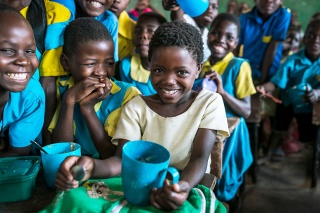
Providing a daily meal to vulnerable children in their place of education
We work in areas where children experience high levels of poverty, food insecurity, and malnutrition, where providing locally-run school meals encourages encourages increased school enrolment and attendance rates. We have a deep resolve to reach children who live in particularly challenging, unstable, and food-deficient areas.
The promise of a daily meal promotes inclusion by enabling children who are marginalised, vulnerable, or living in poverty to enrol in school and attend consistently, and the community-based feeding programme helps to foster a spirit of hope and collaboration throughout the school.
Partnering with communities, schools, and local organisations
Equal, long-term partnerships between communities, schools, Mary’s Meals and our partner organisations are central to our community-based feeding programme.
Local communities take on the day-to-day running of our programme with our support, so before we begin serving in a new place of learning, we work with the school and surrounding community to ensure that they can commit to what’s required.
We encourage parents, teachers, and other community members to establish a school feeding committee, which will be responsible for managing the programme (including ensuring there are enough volunteers to prepare and serve the meals), resolving any issues, and promoting school feeding within the community. Mary’s Meals staff and partners provide training, resources, monitoring, and support to schools and volunteers.
Tens of thousands of volunteer cooks commit their time to prepare and serve our meals daily. This strong community ownership helps to build capacity and potential for school feeding to be delivered locally in the future, while increasing the cohesion between the school and the local community and promoting better understanding of the importance of education.
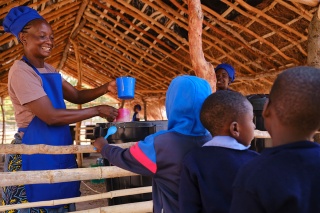
Delivering consistent, high-quality school feeding programmes
In each country where we work – either directly or through a local partner – we agree with schools and communities which foods should form the basis of a locally appropriate and nutritious school meal, often fortified with vitamins and minerals.
Local food procurement happens centrally and at scale, helping to ensure a timely and consistent supply of good quality food for the meals. Our staff and partner colleagues work hard to manage the food supply and monitor the programme, making sure that every school receives and serves the right quantity of food.
We ensure that schools and communities have the knowledge, skills, equipment, and support they need to be able to take ownership of school feeding and implement the programme in line with our policies and model. School Feeding Officers monitor stock and programme implementation, and support the school feeding committee to maintain good practices, as well as identifying solutions if challenges arise.
We find that our work often acts as a platform to support further change and improvement in the school environment, since school feeding committees are well-placed to engage with other positive interventions; for example, initiatives relating to children’s health or the environment.
Sourcing locally grown food and minimising environmental impact
We are committed to sustainable school feeding, and so the vast majority of all the food purchased by Mary’s Meals is grown in the countries where we work. Where possible, we focus on purchasing equipment locally and working with local food suppliers who buy from smallholder farmers, helping to support farmers and their families, and encouraging economic growth. When good quality, locally grown food is not consistently available, we use alternative options, while continually pursuing opportunities for local procurement.
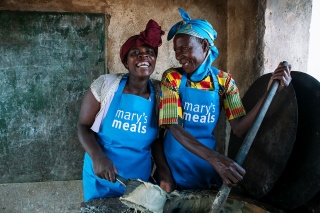
Building brighter futures
Our community-led school feeding is about more than just providing meals – it’s about bringing hope.
By mobilising local communities and supporters across the world, we rely on the innate goodness of people to feed hungry children and help them to build brighter futures. Thank you for standing with us in our belief that every child should receive a daily meal in their place of education.
